Some Notes and Words I learned or remembered reading Sally Mann's book 'Art Work: On the creative life'
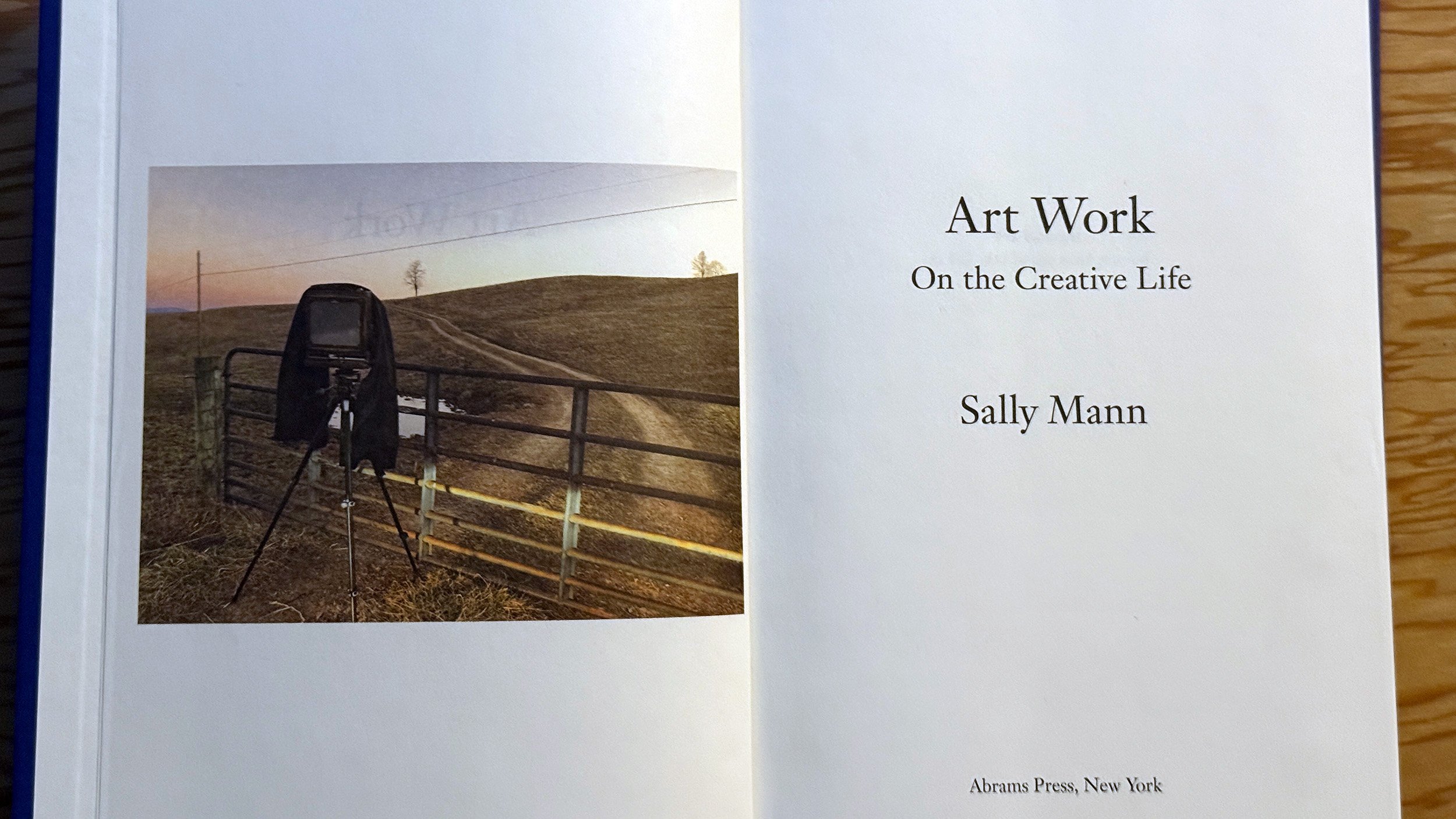
Sally Mann’s recent book, “Art Work: On the creative life” (September 2025) came to me by accident and in it Mann writes how often accident and luck intervene in her photography practice and how the practice is the important part of the practice and that life is and isn’t only about art but both are part of the practice.
Specifically, Mann shares her accomplishments, good luck, and bad decisions equally in this casual and friendly memoir-ish account of instances when she knew she was on a path toward a larger or more-specifically-her-own narrative, and that she kept practicing through times when she didn’t know that her practice, her photography work, was on a path toward any narrative at all.
It was good to read again how much time art takes and how many experiments are required to discover one’s voice and how many times these experiments lead one to wonder that any other occupation would make more sense than trying to make art for a living. Mann describes that the path toward discovering one’s voice is a process—there’s never a codified moment without a lot of practice—and that, “There’s no way to know what you’ve discovered until you’ve been there.”
I love her self aware and self effacing wit and her unusual way with language—lyric, poetic, and surrounded with the loveliest Southern patina—as if the book is a conversation with herself that she invites us to overhear her way of feeling through our world. And I enjoyed the many trips to look up words that are not normally, or rarely, or sometimes used and just odd enough to look up again and many for the first time.
Highly recommended and especially for artists and creatives who may be questioning the whether and how of continuing into the unknown daily practice of artmaking.
In this book, Mann is for me a mentor willing to share the accidents, luck, and daily grind of her practice and to show me that “the measure of artistic success is not money, it is time.”
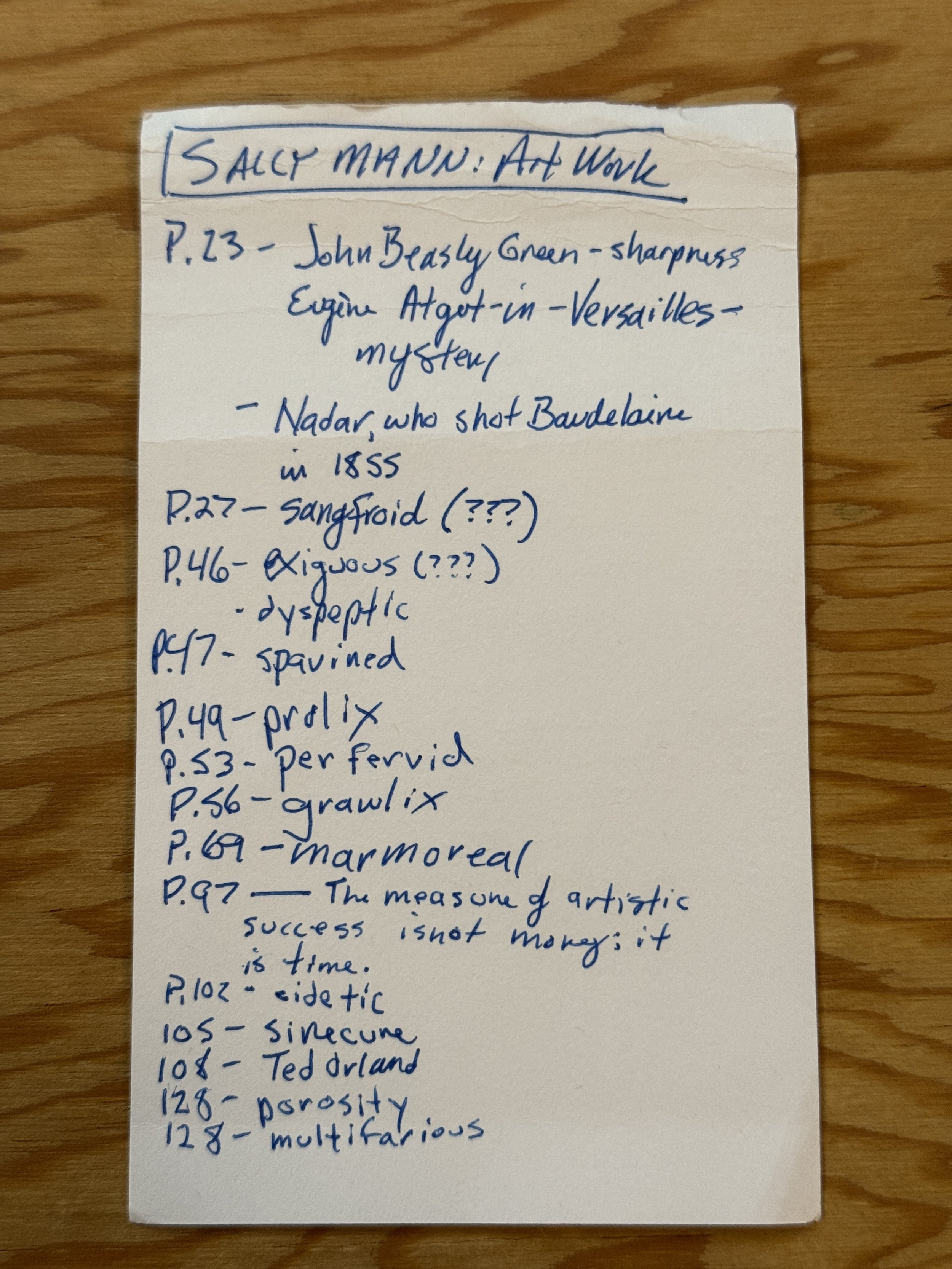
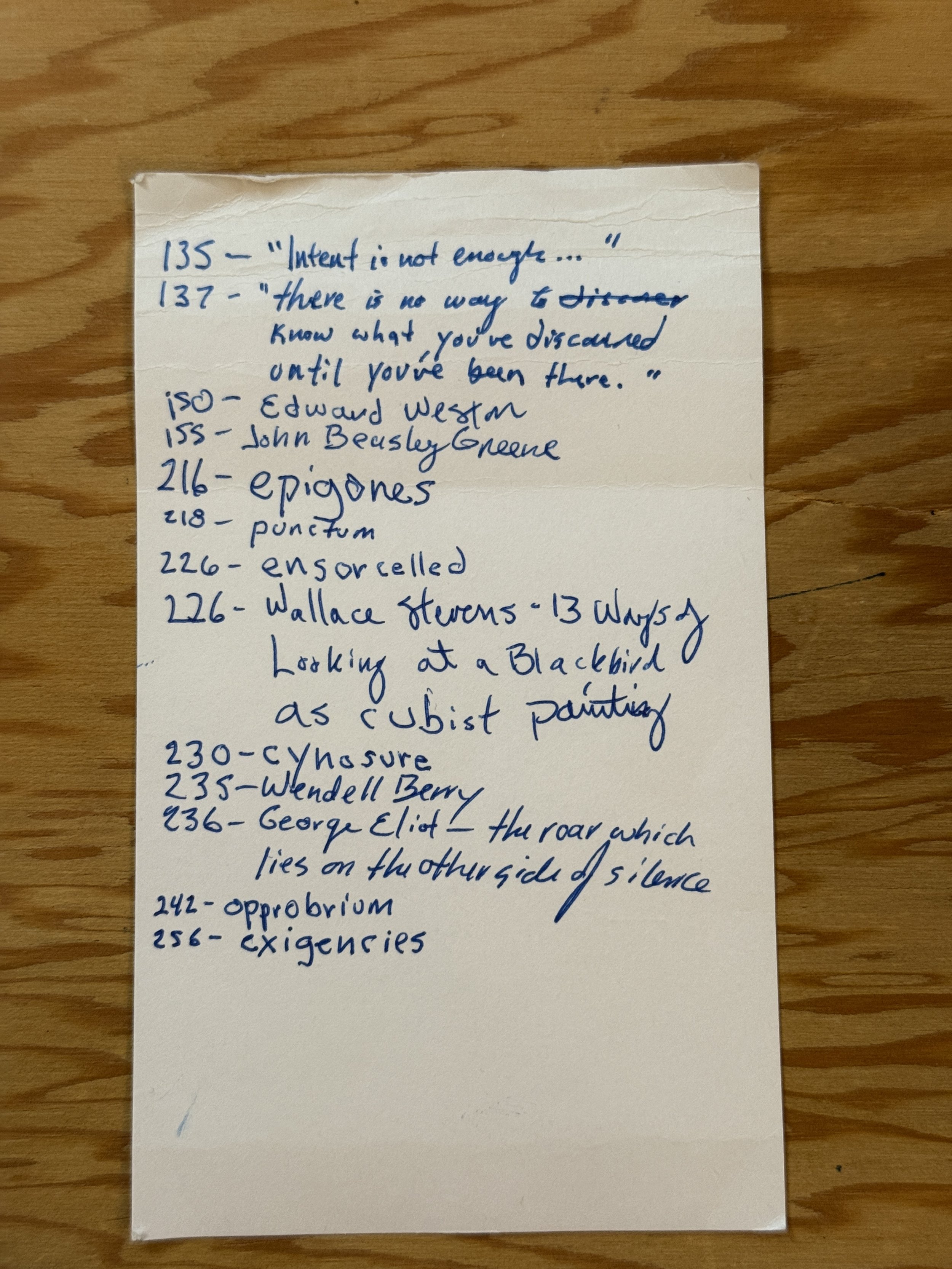
Some notes and words while reading Sally Mann’s book “Art Work”
Page 27: sangfroid - cool headedness especially when stressed. Here’s the French pronunciation.
Page 46: exiguous - tiny or meager
Page 46: dyspeptic - (I never remember the exact meaning of this word and rather let the sound of it remind me of a vague meaning) - literally a digestive issue and often used to mean irritable or sickly
Page 47: spavined - of course Mann, a lover of horses, would use this word to describe her hands working to type the manuscript for this book. Refers to a bony swelling in the hock bones of a horse and an older, less used meaning is decrepit.
Page 49: prolix - unlike verbose which means “to use many words,” prolix slants critical toward a tedious use of so too many words (like a novel I’m loving but finding prolix).
Page 53: perfervid - excessively passionate
Page 56: grawlix - “In a 1964 article for the National Cartoonist Society, Beetle Bailey creator Mort Walker coined the term grawlix, which, after a bit of evolution in its meaning, now refers to the string of typographical symbols that sometimes stands in for profanity.” - via Slate Sept. 2013
Page 69: marmoreal - why do I not ever remember this word exactly? Of or having to do with marble. And/or - the name of the kingdom of the White Queen in “Alice in Wonderland.”
Page 97 note/quote: “The measure of artistic success is not money; it is time.”
Page 102: eidetic - of course I always remember this as “photographic memory” and technically it’s extraordinary accurate and vivid recall (especially of visual images (as opposed to the experience of metaphor in poetry where two images combine using the abstraction of language to produce a third?)).
Page 105: sinecure - “is a position with a salary or otherwise generating income that requires or involves little or no responsibility, labour, or active service”…so, an associate producer credit? Just a joke.
Page 128: porosity - a measure of empty space - what a rabbit hole into physics looking at the technical definition.
Page 128: multifarious - many parts or aspects. Just checking my memory on this one.
Page 135 note/quote: “Intent is not enough…”
Page 137 note/quote: “There’s no way to know what you’ve discovered until you’ve been there.”
Page 150 note: I really need to learn more about Edward Weston
Page 155 note: and John Beasley Greene’s photography
Page 216: epigones - used as “an inferior imitator”
Page 218: punctum - multiple meanings: a small distinct point or object and/or a tear duct
Page 226: ensorcelled - to captivate, to enchant
Page 230: cynosure - something that attracts attention by its brilliance
Page 235 note: “Wendell Berry” - she writes about a poem of his but and so why did I make this note?
Page 236 note/quote: “The roar which lies on the other side of silence.” - George Eliot
Page 242: opprobrium - real definitions vs usage here…usually something that brings disgrace or it can mean harsh criticism.
Page 256: exigencies - an urgent need or something that requires immediate attention. Isn’t this the name of a poem, or collection of poems?